
The Big Book
On the eternal conversation of poetry

I’m a novelist and TS Eliot Prize–shortlisted poet. Monday Night Reads brings a piece of thoughtful writing to your inbox each week.
If you’d like to support my work, a paid subscription, or a coffee make a real difference. I appreciate every one. Thank you.
Dear Reader,
It was a good offer. The Aer Lingus check-in lady at Cork Airport knew it was. She smiled patiently, confident in my decision.
250 Euros not to take this flight, which was overbooked, and take the next flight back to London. All I had to do was wait seven hours. I looked round the tiny departure lounge, tried to visualise myself being paid to exist there for a working day.
The offer was more than most appearance fees these days. More than a publication fee. It was money for nothing. And I’m a writer grown cactus-like after years of literary drought.
However, I had been awake most of the night, so keen was I to be early, avoid trouble, and get back by mid-afternoon – there to sink into silence, return to the chrysalis I call home and sleep.
I realised that, generous though it was, I couldn’t accept. The weariness that engulfs me after – especially after – a joyful time can’t be overridden anymore. I wondered briefly what price would have had me agree to sit upon a little steel chair for seven hours. Everyone has a price for everything, I thought. But I was too tired to think this through to an actual number. Instead, fielding the lady’s gentle disappointment which somehow cut me to the quick, I said ‘Ah, I can’t I’m afraid. I really need to get back.’
It was really my soul speaking, not me. For when I did reach my boat, I did exactly as I planned, and more. I went to bed and did not surface for 36 hours. I have, in fact, only surfaced to write this.
It’s a specific kind of exhaustion, peculiar to the aftermath of good events. It exists in parallel with replenishment, which only real literary company can bring. Cork Poetry Festival was, I think, the most generous and enjoyable literary festival I have ever attended. I was deeply replenished – and utterly depleted.
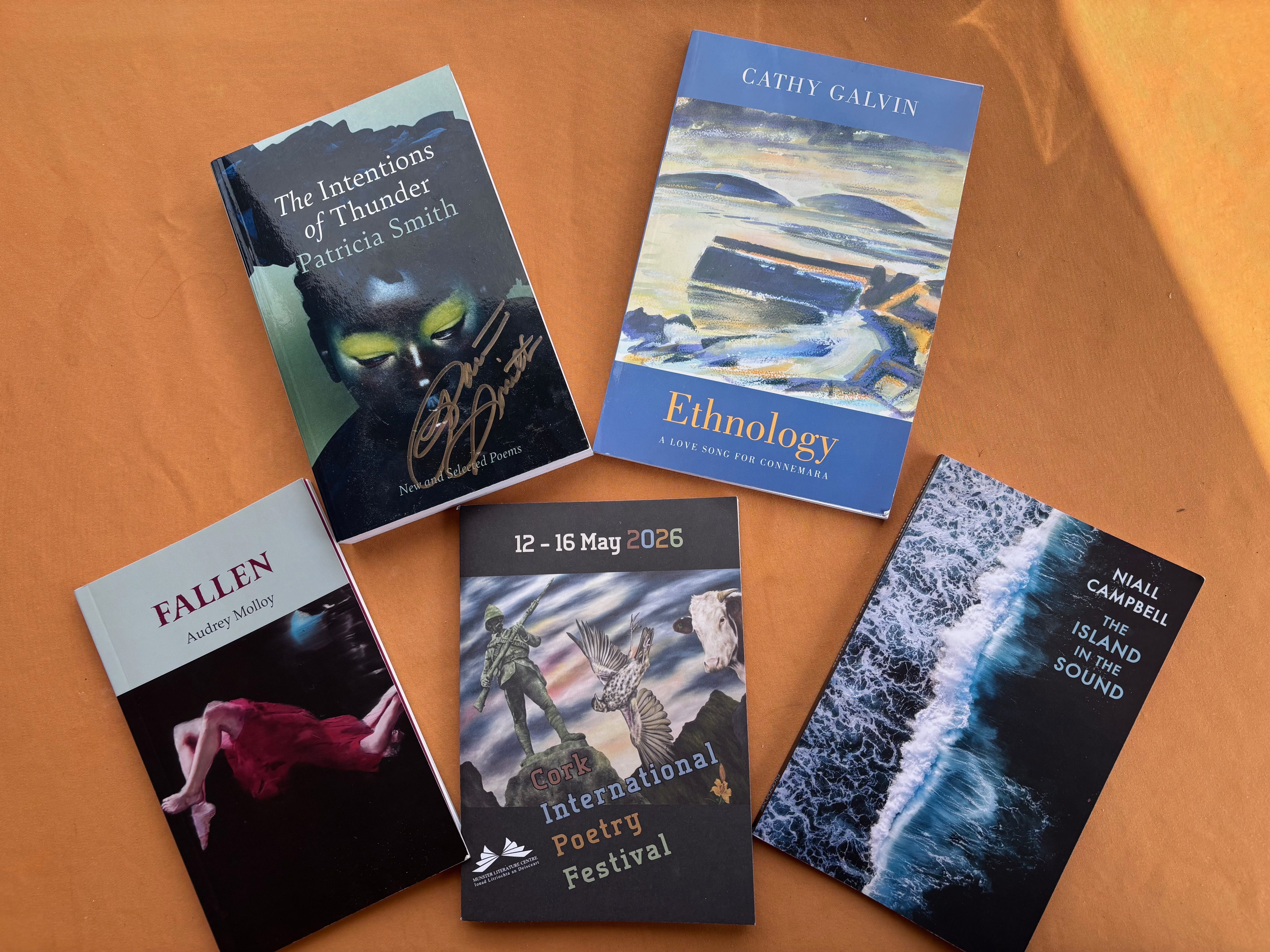
Running over five days, the festival is the brainchild of Patrick Cotter, who encourages the poets he invites to stay a while and encounter one another properly. All the poets are in the same hotel, and gather naturally together to chat, discover each other’s work and attend each other’s events, which are held every evening in the local theatre.
The first night, I attended all the evening readings – more than three hours of poetry, which flew by. I haven’t been around so much poetry – or so many poets – in years. Poetryland, and the online world surrounding it, can feel fragmented and factionalised now, making it strangely difficult to enjoy even the simplest forms of literary society. But this was all about the work. Patrick had paired poets with thought and imagination, which made each event a real discovery of others’ writing.
What Patrick also understands is that poets require looking after. Not extravagantly, but properly. The rooms in the hotel were comfortable and – miracle of miracles – mine had a bathtub.
Those who know me will understand that this is the direct pathway to all my human goodwill; direct access to the best of me. My boat has no bath, which means I am denied one of my favourite activities. It is the only real privation of boat life, and has caused me to add a caveat to my friendships. Can I have a bath at your place? If yes, then we are golden. If no, then sadly, well…
Anyway, I got four baths in during the two-night stay, and almost managed a fifth, but it was 2am on the morning of departure and I became afraid I’d fall asleep in there and drown and/or miss my flight.
So the cared-for poets were relaxed and happy, and fascinating. Our conversations flowed from a shared love of the craft that rose above the pettiness that has sometimes characterised literary life for me in recent years.
I made several discoveries, and one of these was Patricia Smith, an American poet of stellar reputation whom I encountered for the first time. Smith has also recently published a New and Selected, though she has arranged hers differently to mine, placing the new poems at the end. Her long poem “70”, with which she opened her set, was a high-octane blast of humour and pathos, speaking straight to my own poetics from across the vast hinterland of very different lives.
Well first, it seems immeasurably unjust
that no one clues you into this bombshell — you
will lose your public hair! No one brought up
this grave development, the swift debut
of silver slowly turning a soulless grey,
then just an anarchy of wire, ‘til one
by one, your glistening strands betray
you, disengage and drift. Behold and lo,
you’re bald in undreamt ways. My perfumed kink
and curl, dense lace embellishing the door
to everything, no longer shines its light
for episodic visitors. I own
a home not quite abandoned, simply stripped,
the fireplace still ablaze within its walls.
From ‘70’ in The Intentions of Thunder: New and Selected Poems by Patricia Smith (Bloodaxe Books, 2026)
We both spoke in our sets about the strangeness of having a selected. No matter how you curate it, there is the unsettling realisation that the work is no longer about emergence but duration. There is a past. A body of work. One is, unavoidably, older.
In the audience’s response to my own reading, I suddenly saw myself from the outside: a poet choosing and contextualising from a body of work that demonstrated, across time, a distinct sensibility. This is the poet I am.
It’s the kind of realisation that makes one long for a nice deep bath to contemplate. Instead, we gathered in stages at the hotel for late-night drinks and a different kind of contemplation.
Too tired to drink more alcohol, I was bought a pot of tea by Peter Fallon, the legendary publisher of Gallery Press and an iconic figure in Irish poetry. He belongs to the generation of poetry publishers that those of us with New and Selecteds now look towards with a certain anxiety about succession, aware of the importance of their lists and wondering what happens when the seemingly impossible finally happens.
He is, however, full of life and mischief, as interested in the new as in the greats of the past.
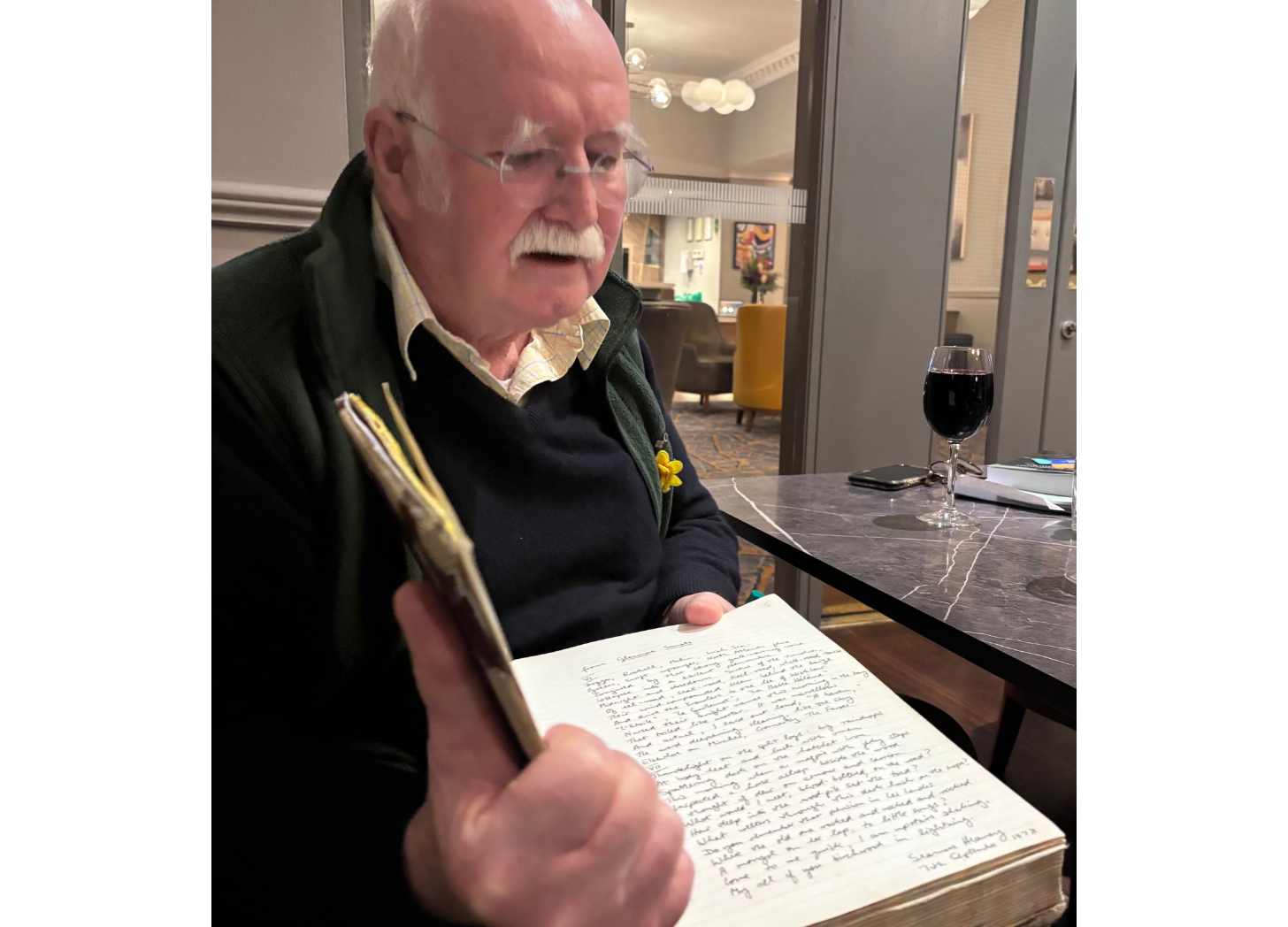
After a while, he said he had a favour to ask of Niall Campbell and me. He excused himself and returned bearing something that drew gasps from the gathered poets: the Big Book.
This is a huge notebook dating back to the 1970s, with the heft of a Book of Kells. The pages are yellowing now at the edges. In it, the poets and writers of Peter’s acquaintance have written poems or messages over the decades. Astonished, I turned pages and found Raymond Carver. Seamus Heaney. Infinitely various handwriting. Drawings. Time itself unfolding through paper, like unearthed scrolls.
Of course I squealed when I came across Ted Hughes.
Peter then invited Niall and me to write in the Big Book ourselves, leafing through to find a space. I was so excited I forgot the lines of the poem I’d chosen, and had earlier that evening given my reading copy of Afterlife to Patricia Smith. Audrey Molloy eventually brought the poem up on her phone from the Poetry Archive, and painstakingly I copied it onto the indicated page, almost as though it were a poem by someone else, feeling it become part of a greater whole in the act of writing.


I always wanted to meet Ted Hughes, and nearly did once or twice. Now perhaps I have, in the only way that matters in the end: through the work.
The realisation dawned that poetry operates on a different timescale from literary fashion, argument, or reputation. If you’re lucky, you get to go on adding your small mark to the long conversation.
And perhaps that is enough. Along with a soft bed to sleep in afterwards, and the occasional bath in the home of a friend.


Thank you for reading,
Until next time,
Polly
Work With Me
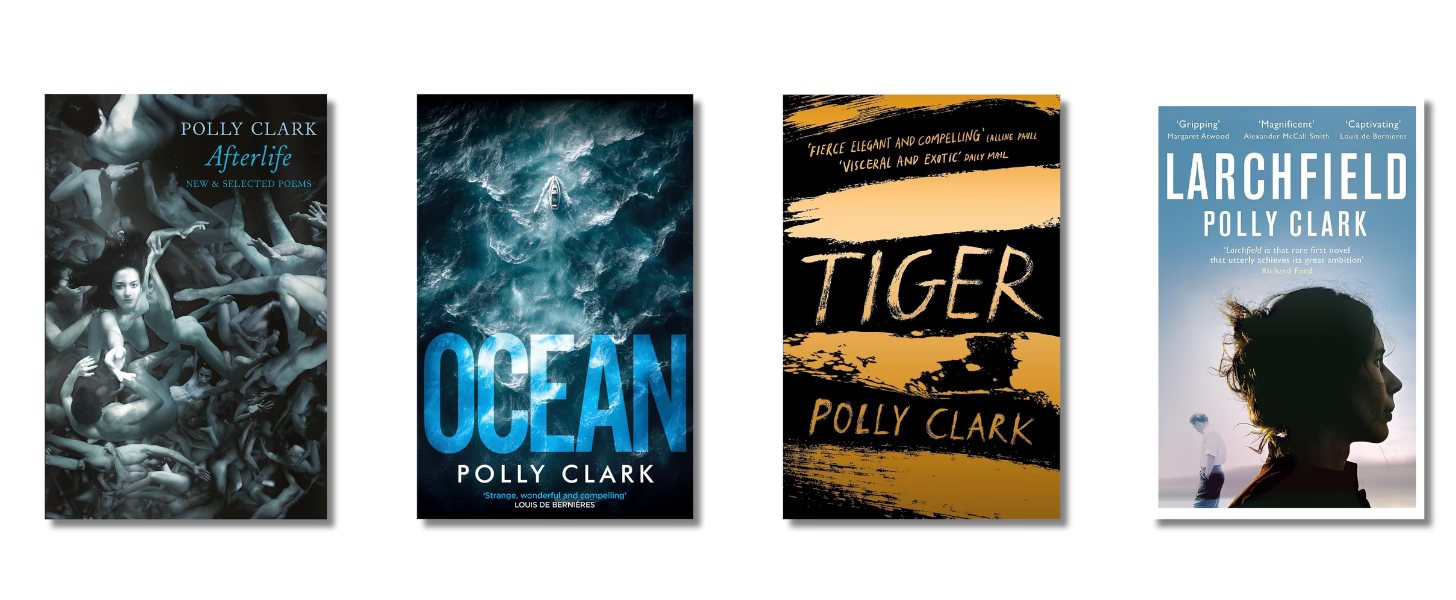
I’m the prize winning author of four poetry collections and three novels, currently working on my fourth novel. I have many years of experience in writing successfully across genres, and in helping other writers succeed.
I offer affordable one-to-one writing sessions, where we can work together on a piece of writing, and a weekly Hour Club for focused writing. You can find out more here.
If you’d like to make progress with your writing – whatever stage or type it is – get in touch and let’s get you moving.
You can email me at: pollyclark@substack.com or paid subscribers can message me below.
That moment produced a sharp intake of breath and vicarious joy, thank you!
Now that sounds like a Festival worth attending; I looked at the program for the Melbourne Writers' Festival. Dross, from start to finish, no wonder it has to be heavily subsidised.