
You Should have Saved Me
Female experience is universal at Tracey Emin: A Second Life

I’m a novelist and TS Eliot Prize–shortlisted poet. Monday Night Reads brings a piece of thoughtful writing to your inbox each week.
If you’re new here, you might begin with The Vanishing Review, a short series reflecting on the events surrounding the publication of my new book, Afterlife: New and Selected Poems.
If you’d like to support my work, a paid subscription, a coffee, or buying a copy of Afterlife all make a real difference, especially at a moment like this. Thank you.
Dear Reader,
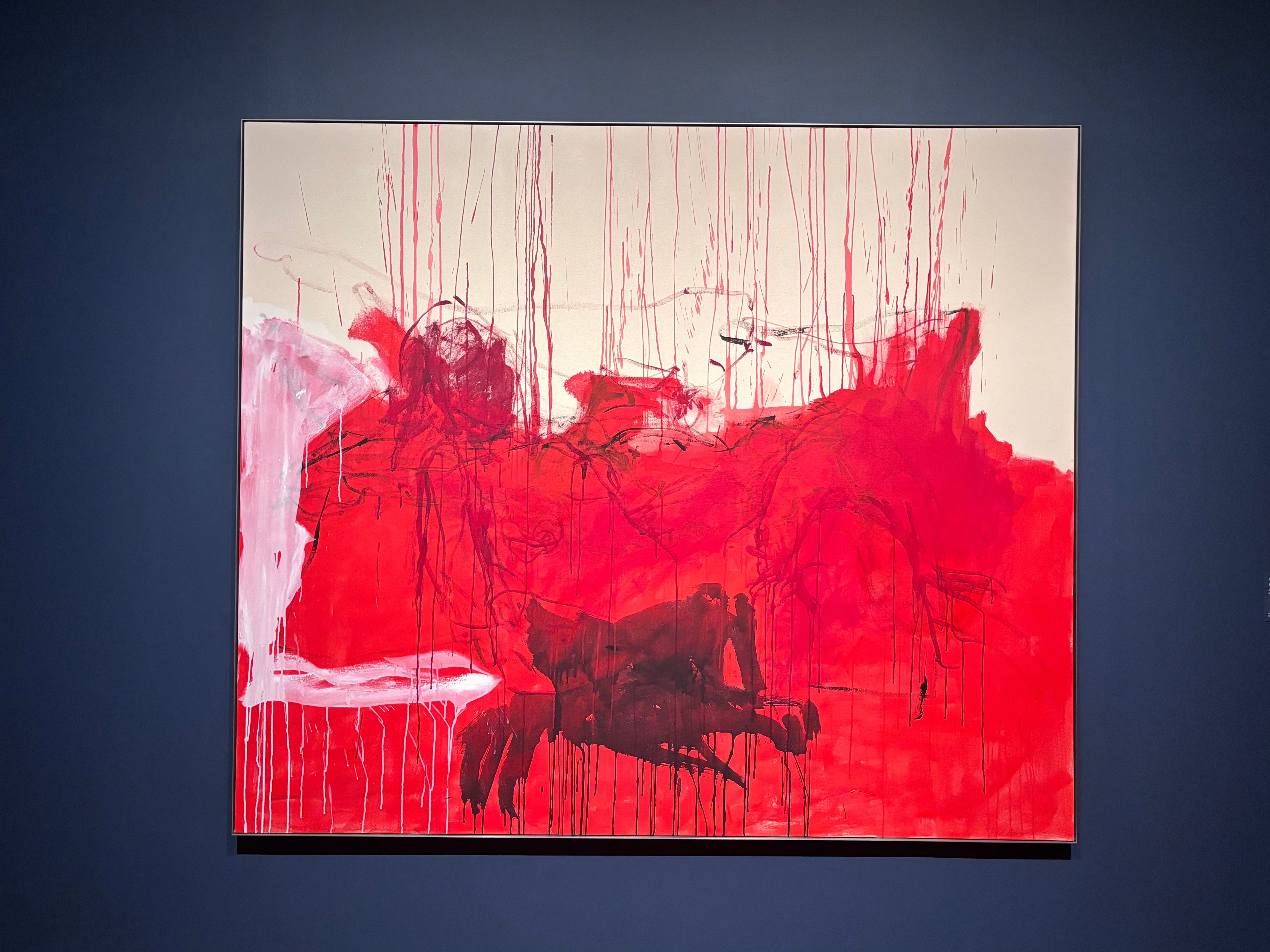
While I left the Tracey Emin exhibition biting back tears, it also left me with a powerful sense of permission. Emin centres intense pain in her work, and goes wherever that takes her, with no apparent concern for whether it will be recognised as art or not. In some pieces, it feels as though she is trying to remove herself entirely. The exhibition becomes a series of attempts to let that pain reach the viewer unmediated.
What Tracey Emin: A Second Life tells me is that it is not only permissible but necessary to look directly at the hardest, darkest parts of our human existence. This is where something essential happens – recognition.
It is brought home nowhere more strongly than in How it Feels (1996). Even the title refuses interpretation. One moment from this devastating 22-minute film about her botched abortion will stay with me, though, like much here, it is not a print I can take home.
Talking about the aftermath of this life-defining event, after which she committed what she calls ‘emotional suicide’, destroying all her previous work, she pauses. Then she takes off her rose-tinted glasses – literally – to show us her eyes. The camera comes in close. Her eyes are deep brown. She says (I paraphrase): You can see it in my eyes. Like a tree in winter. All the foliage is gone, dead, but the trunk is alive. That is heartbreak.
Several people left before the end of the film. It is relentless, and hard to sit through. But what it insists on is not explanation, nor argument, but simply this is how it feels. There are experiences that resist being translated into anything more manageable than that. They can’t be smoothed into discourse. What art can do – and arguably that is its value – is hold them.
Emin’s great achievement, I think, is to refuse the shame that would otherwise have crushed her. Her work cumulatively creates an iconography of innocence. Sex, abortion, illness, loss, rape, blood – these are presented with a forensic directness that bypasses analysis. If anything, the innocence at their core becomes more visible as the horror accumulates.
The artist, at some level, must remain a child. Innocence is shameless. It does not turn away. It meets heartbreak, even destruction, with curiosity rather than defence.
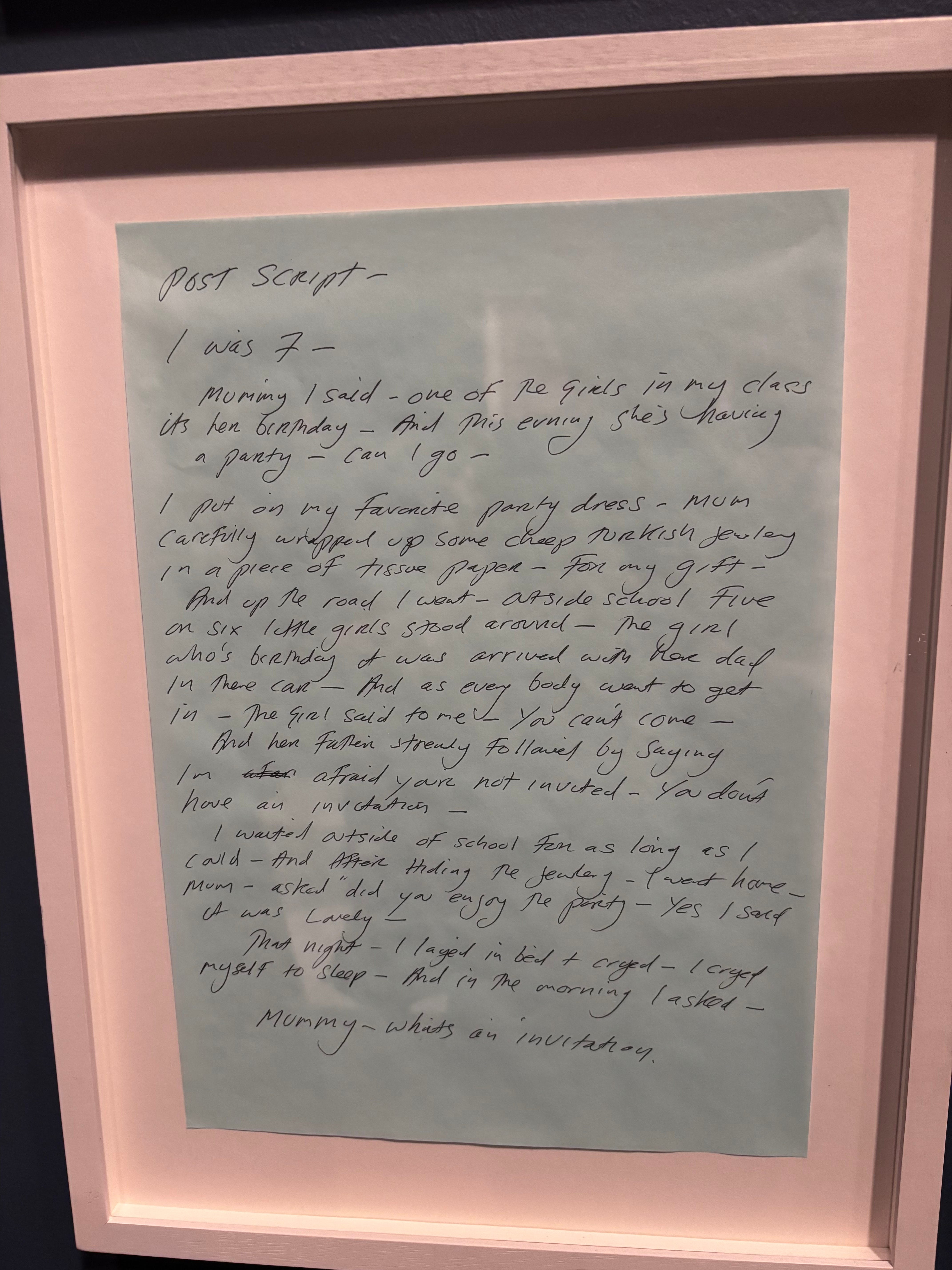
And what triumphs in Emin’s work, through all its devastation, is innocence. The courage in that took my breath away.
Thinking about it afterwards, I could feel the distance between this unmediated blast from the artist and the way I have learned to move through the world: shame has so often made me an intermediary between the world and my work. As if, by being acceptable in life, I could smooth the way to the truths in my writing. But there is a danger in that. It becomes a form of misdirection.
A few years ago, I went to a literary party and met one of my foreign publishers there for the first time. A brilliant and generous woman, we chatted for a while and then she said, ‘I cannot reconcile this person in front of me with the craziness of your book! You’re so… normal!’ We were talking about Ocean, which is indeed the most painfully mad of my novels.
I recognised what she meant. I have worked hard to make myself legible. The danger is that the instinct to anticipate, to make yourself frictionless to others, does not stay in the room. It follows you back to the desk. It can begin to shape what you allow yourself to say, and how far you will go. It begins, quietly, to poison the work with shame.
Now I see that there is another way: Tracey Emin’s. To let what you have made of your pain go into the world unmediated. The liberation of that is enormous.
I do not know how much is owed to the meticulous curation of her work here, done with honour to its subject. I suspect no small amount. Another striking success of the exhibition also made me wonder about this.
Emin’s canvas is insistently her own female body and experience. But her work spoke to me not only as a woman but as a human being, and as a creator. In fact, I do not remember seeing the word ‘woman’ there at all. And though there were the usual trigger warnings, there was no intrusion of ‘gender’ as a framing device. Emin presents her experience as her own. It is not mediated through any historical or political context. It is deeply personal, yet free of the usual cultural lead weight attached to female experience.
In these febrile times, that feels radical. Realising that I only noticed this lack of framing afterwards suggests that it was not imposed in the curation, but allowed. There is nothing reductive here. The exhibition honours Emin not on a ‘female’ scale, but on a human one. The effect is extraordinarily powerful.
For it gives the work its universality. A long film detailing her abortion becomes, in the end, about creation, loss, love. It is grounded in a specifically female experience – it could not exist without it – but what it reveals is not gendered, nor politicised. The questions she is asking, and the resolution she arrives at, are human.
In these times of life-sucking identity-based curation, this is a breath of fresh air.
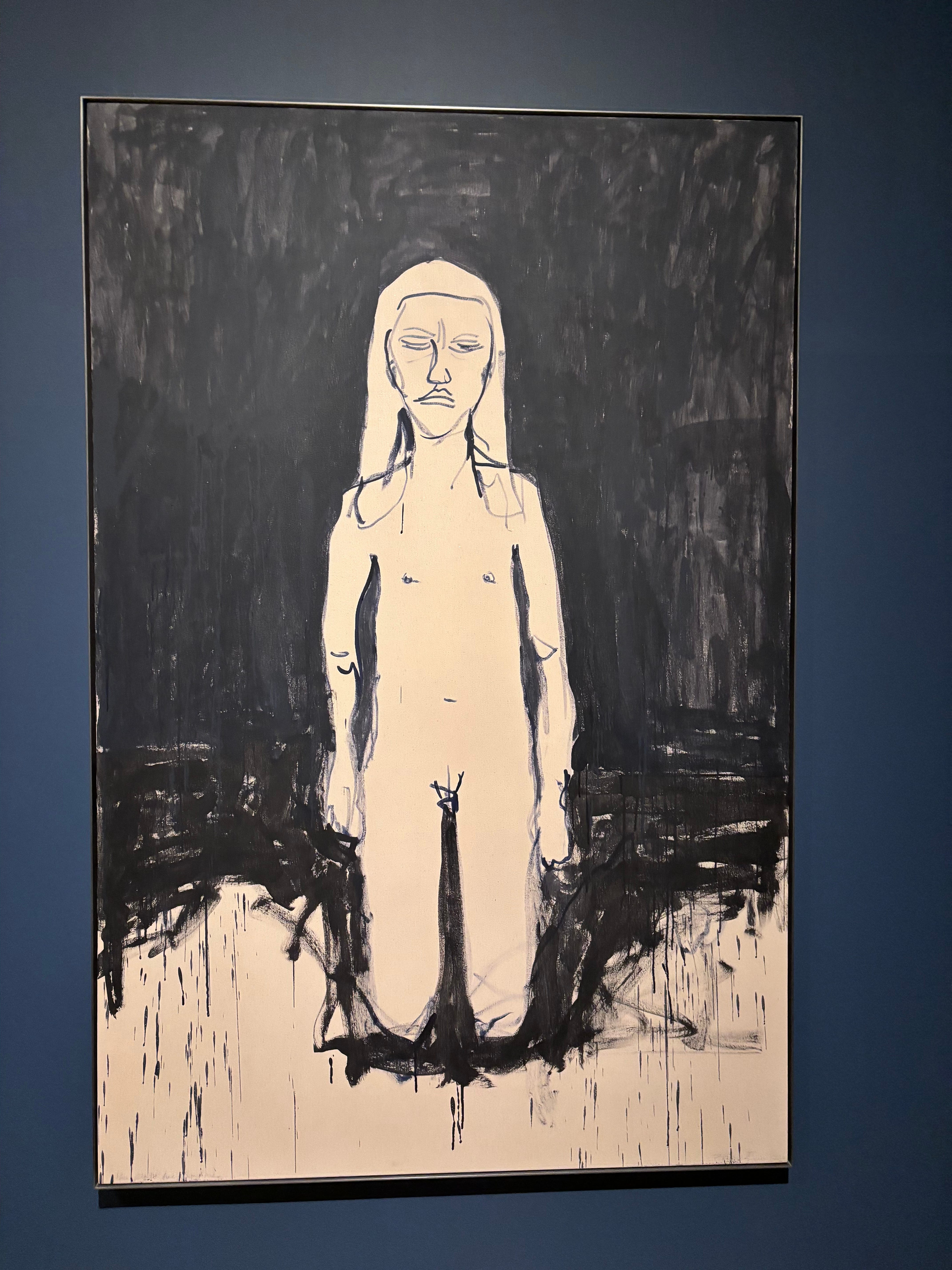
It felt particularly resonant at Easter – a time shaped by the image of a body suffering, abandoned by all. “You Should have Saved Me” felt like an alternative cry of, “Father, why have you forsaken me?” Walking through the exhibition, I became aware of how often Emin returns to the female body as abandoned and sacrificed, not symbolically, but materially.
We are used to that kind of meaning being carried by a male body. It structures one of the central stories of our culture. What is less familiar is to see a female body holding that weight. Furthermore without the caveats usually applied when the female body is ‘speaking’. As you walk through the rooms of A Second Life female experience is rendered insistently as universal human experience.
How it Feels was perhaps the most powerful example of this. There were men in the audience, probably fewer than women, but several of them sat through the film. The sadness, pity and shock that the film evoked were clear on their faces. It spoke to something in all of us.
The film is hard to watch, as it should be. Nothing in Second Life has been contextualised, explained, or made acceptable. Tracey Emin offers her soul in her work, and her curators have kept out of the way.
Tracey Emin: A Second Life is at Tate Modern until 31st August 2026.
Until next time,
Polly
If you value my work here, please consider supporting it, through a subscription, a coffee, or by buying a book. Your support keeps this site afloat, and enables me to keep writing.
New readers may also enjoy my interview with Graham Linehan, or the Letter From A Poet series, which includes recordings and essays from Afterlife. Further information about the book can be found here.