
The Job Application
A cautionary tale

Dear Reader
A few weeks ago I applied for a part time post teaching on the Writing Poetry MA for the Arts Council funded Poetry School.
The Poetry School was founded in 1997 by the poets Pascale Petit, Mimi Khalvati and Jane Duran, offering classes in poetry in London, and, later expanding in a kind of franchise arrangement across the country, where poets can run their own affiliated courses. With Arts Council England funding they have grown further and now also run an MA in Writing Poetry in collaboration with University of Newcastle.
The advertised MA tutor post is part-time, based in London, with poet Glyn Maxwell as co-tutor.
Why did this post catch my eye? The call for applications was different for a start. Sent by email by the co-CEO James Travelyan to the Poetry School mailing list, it thereby reached out to poets, not only academics. These days a poet or writer being employed to teach at university level because of their body of work is a vanishing rarity. Writing and ‘the Academy’ have merged, and a PhD in writing is now more valuable than the writing itself. So this stood out. Intrigued, I thought it worth looking at the job spec.
The spec asked for someone ‘established’ in the UK poetry world as a key requirement. My 25 year retrospective Afterlife: New and Selected Poems has just been published, to considerable acclaim (some of it Schrödinger’s acclaim in that it vanished when published, but still).
Also unusual was that the post asked for a CV and personal statement, rather than an online form. This is almost extinct as a practice now, and gave me confidence that they were interested in my variety of established – poet rather than academic; someone who would shine with this old-school approach.
The more I read the job spec, the more of a potential match I felt there was. I have attached this document, and my application, as PDFs so you can see the two together.

So energised was I that I overlooked the glaring red flags. In retrospect I should have pointed out to the Poetry School that they were operating unlawfully, and then bowed gracefully out. I have done this before. But, reader, I need to eat – and I thought I had a chance.
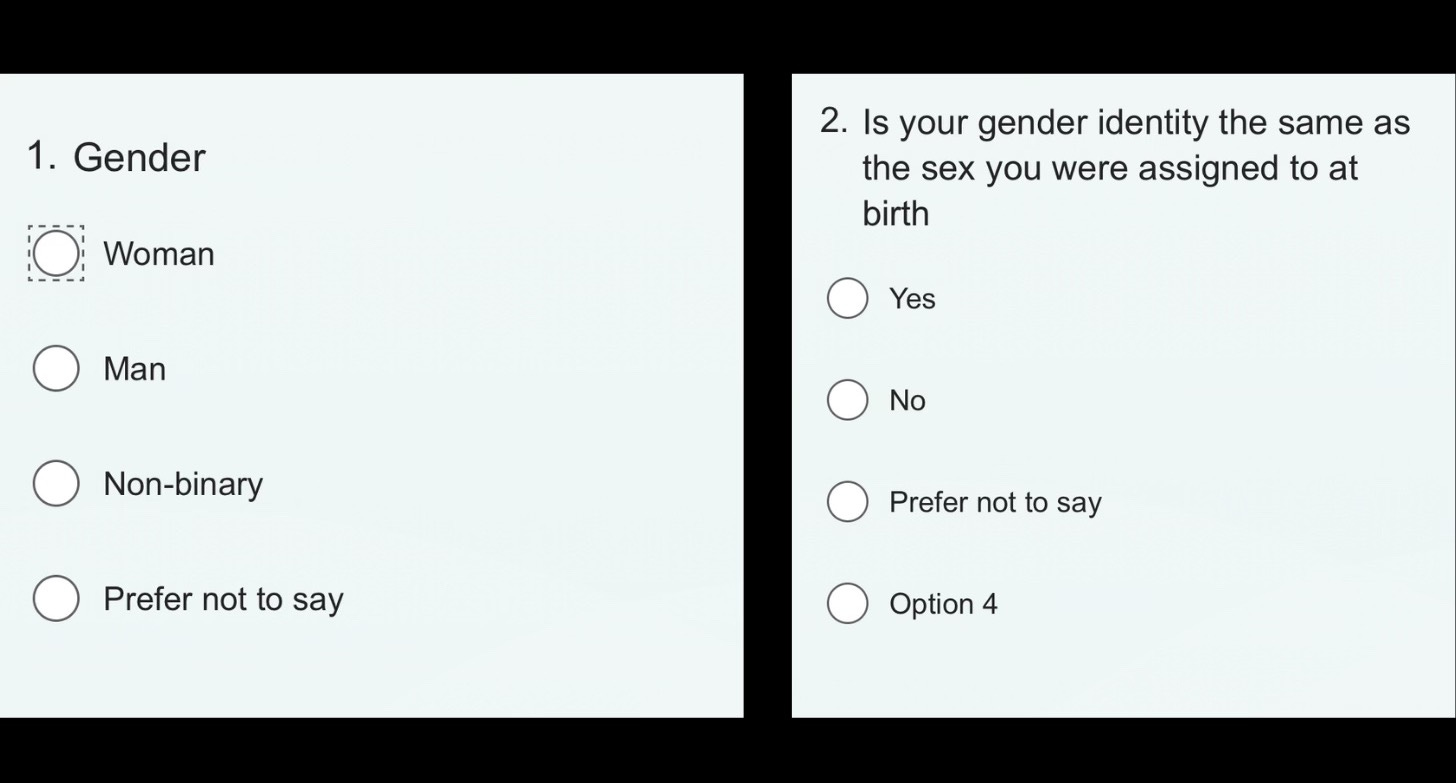
The first of these glaring flags was the Diversity and Inclusion Survey which all applicants are requested to fill in. This is to collect data for the Arts Council. This one was incorrect, muddling sex and gender, such that I could not answer it accurately, and any data collected through it is highly questionable. Those of us who have been on receiving end of discrimination over our gender critical beliefs are worn out by explaining the same thing over and over: gender is not a protected characteristic – data for this does not need to be collected. Sex is a protected characteristic, and data for this needs to be collected.
So, an important question for the taxpayer funded Arts Council: Are funding judgements based on this kind of faulty data?
The spec ended with a truly astonishing clause. What I think is happening here (to give the most generous spin I can) is that this is an amped up version of the clause that used to appear in application forms, attempting (in good faith it always seemed) to demonstrate the employer was concerned with fairness. It was usually something like : “Company X is a fair and inclusive employer and especially welcomes applications from minorities and those with disabilities.”

The Poetry School version of this makes a mockery of that good faith attempt at fairness. Applications from those with disabilities or from the ‘global majority’ are not only encouraged – applicants are guaranteed an interview if they have ‘demonstrable experience’ in meeting the key criteria. Now, I am not a lawyer, but I do know that positive discrimination is unlawful in the UK. Shouldn’t everyone with demonstrable experience meeting the key requirements be offered an interview?
It is not lawful to cherry pick among protected characteristics: the point of the Equality Act is that everybody is protected from unfair discrimination.
It gets worse. The Poetry School then go on to undermine comprehensively their show of inclusivity. First, the ‘global majority’ is not defined. If I were to be facetious I might have included myself: women are the global majority. If you are guaranteeing interviews to members of a group, you surely need to be clear about what that group is.
Then the pièce de resistance: Self-ID. It is extraordinary that this term is still being used in 2026 by an organisation funded by the taxpayer.
I have been told by a source within Arts Council England that self-ID in recruitment is widespread across ACE-funded organisations and within ACE itself. I have not independently verified that claim. If true, however, it raises obvious questions about how such schemes operate in practice. Can an applicant, for instance, self-ID as having an invisible disability without diagnosis or proof and collect that guaranteed interview? Could a poetry-land Rachel Dolezal self-ID as Black, and skip in here? If that doesn’t make you angry, it should. I know people genuinely disadvantaged by their disability or their race and it is abhorrent that an organisation will guarantee interviews to anyone who self-IDs into those categories.
(I have also been told that applicants who self-identify into preferred categories routinely dominate ACE shortlists. Again, if this is true, it raises serious questions about HR practices in England’s national Arts funder.)
Let me be clear. No applicant is entitled to an interview. Interview processes necessarily involve preference because some people have to be chosen over others. This was a nice job. There would be many strong candidates.
So I was disappointed to be rejected three days later – but it was the explanation from the Director that made me realise that applying despite the flaws in the process had been a mistake. He took the trouble to write me a personal email, which I appreciated, but this paragraph pulled me up short:
However, I did want to mention personally that we were particularly impressed with your application. We had a huge range of very high-quality applicants – yours included – and ultimately had some really difficult decisions to make to land on a balanced shortlist.
Interesting term, ‘balanced shortlist’. A balance of what? Once ‘balance’ means something other than merit, the applicant no longer knows what game is being played. Given everything I had discovered, I now could not help but wonder if a balance of identities was the aim.
After taking advice, I made a formal complaint about the process. Not about not getting an interview – on that score I was just annoyed with myself for applying. I was advised that by shining a light on what had happened, it might be different next time for the next writer. The organisation might even change. I must confess to being tired of being the person tasked with leading institutions into the light because those who should won’t. But it would be wrong to leave this mess unchallenged, wouldn’t it?
I attach my complaint as a PDF here. I asked for it to be taken to the Board.
Eventually I received a reply from the Co-Director. Lusungu Chikamata started by distancing the Poetry School from the Equalities Form:
The questions on the Equality, Diversity and Inclusion Form are a representation of the data that we are required to submit annually to the Arts Council, and we aim to mirror the language used in their survey. As such, the questions may not have been worded in a way we would have chosen.
Is there any oversight from Arts Council England regarding official documents? Who is responsible for what goes out under the Poetry School’s name? Or the Arts Council’s? Shouldn’t we be able to trust these documents? Especially when they are for official data collection.
Lusungu Chikamata then doubled down on the guaranteed interviews – and did not mention the use of Self-ID at all in his reply.
Both of the co-directors signed their emails to me with he/him pronouns. I am told pronoun flagging remains commonplace across the Arts Council. I believe this now presents a partial and politicised stance to the public – one that certainly alienates those who hold lawful gender critical beliefs – and that such declarations are better confined to personal correspondence and social media profiles.
What I found particularly striking was the juxtaposition. I had raised concerns about Self-ID in a formal complaint and received no response to them, yet the correspondence itself was framed by a practice rooted in the same ideology. It is difficult not to notice the contradiction.
Finally, Mr Chikamata let me know that my application – scored against unknown criteria by an anonymous panel – was not ‘particularly impressive’ nor ‘very high quality’ after all. It was barely middling. I scored 17.5 out of a possible 27.
I will never know whether I was competing in a merit-based process or an identity-based one. This matters beyond just one poet’s cautionary tale: the arts depend on trust: trust that opportunities are awarded fairly, that public money is being spent responsibly, and that excellence matters. Artists and audiences deserve better than this.
Do please share this post widely.
If you’d like to support my work, a paid subscription, or a coffee helps me keep writing. Thank you so much.
My latest novel Ocean is out in paperback, described by Louis de Bernières as ‘strange, wonderful and compelling’. Afterlife: New and Selected Poems is also available, praised in the Sunday Times for its ‘varied and wise transformations’.
Thank you for reading
Until next time
Polly x
Your application is seriously good, Polly. It would give a normal selection panel goosebumps. I am so angry that they could also be impressed but decide not to interview you, in the woolly and vague interest of balance. This willingness to put quality and integrity second to a very modern idea of virtue is very worrying. Well done on taking them on. You would have been brilliant in that role. ♥️ Think I am going to re-read Tiger in Gran Canaria in the summer. 🐅
I think you dodged a bullet there Polly; students accepted for admission to the Poetry School may be very fragile and exposure to forthright opinions may have been quite frightening. I sit on the board of many not for profit arts organisations and we are routinely required to undertake 'Cultural Awareness' training. I have worked for over 40 years with Aboriginal men and women in remote communities so I don't need any lectures on cultural awareness. Still, you complete the initial questionnaire:
Have you ever been subject to racial abuse?
Yes, when I was in primary school I called a "pommy bastard"
Do you acknowledge any privilege and if you do describe the nature of that privilege
Yes, I was privileged to have been taught that you respect others.
Not the answers they wanted...