
100 percent Human
AI, literary privilege and the myth of the solitary writer

I’m a novelist and TS Eliot Prize-shortlisted poet. Monday Night Reads is my weekly essay on writing, culture and the creative life.
You can subscribe to receive it in your inbox, or buy me a coffee to support my work. Thank you for reading.

On 21 July Substack introduced a new feature for readers and writers on the platform – an AI scanner. Readers can scan any post by a writer they subscribe to and see whether AI has been used in its making.
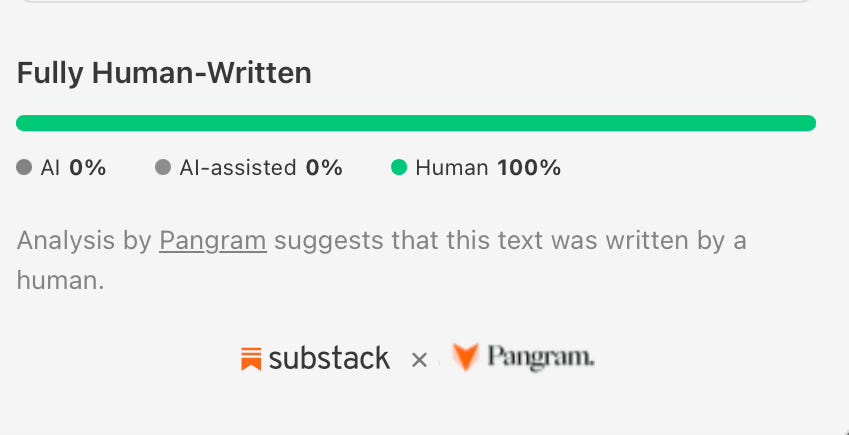
My article is 100% human-written. I am pleased to be able to say this, but Substack’s latest innovation also invites a discussion about AI and its use by writers which I’ve been thinking about for a long time.
This essay is not an attempt to settle the large political and economic questions AI raises: copyright violation, the loss of writing jobs, energy consumption and the concentration of power in the hands of a very few technocrats. Those questions are real and urgent. But they do not exhaust the subject. At the level of the individual writer, something else is happening at the same time. Anyone with a wifi connection now has unprecedented access to research, expertise and responsive intellectual support. This does not absolve the technology of its larger costs. It does mean that, creatively and culturally, AI is already changing who gets the chance to become a fully realised artist and make the best work they can.
The image we have of writers – even of ourselves as writers – is the solitary mind at work. Sometimes this is true: part of the journey must always be spent alone. There is only one way to express the contents of your mind, and that is to sit down and do the work.
But that is only part of the story. Any professional writer knows that having people to read, edit and believe in one’s work is one of the real secrets of success.
Many successful writers have writer friends who read their manuscripts closely out of friendship, editors who go above and beyond to bring coherence from chaos, or partners who listen, facilitate and even edit.
Having these people in a writer’s life is a privilege. But it is one not readily acknowledged. Friends give to friends for free; charmed circles perpetuate themselves. It is those without connections who must always pay for help or expertise.
This accounts for some of the anxiety around AI use. AI has swept in and offers, when used properly, much of what exists in those privileged networks. Not only that, it is available at midnight, never loses patience or demands co-credit, and never asks you to read its novel in return. Suddenly the writer without money or contacts has an infinite army of writerly friends.
This is highly destabilising to established hierarchies, which run on networks of unspoken support. The notion that a writer has succeeded entirely alone is one in which the culture is heavily invested. But the history of literature is full of second minds whose contribution has been absorbed into the more satisfying story of solitary genius. Many great novelists have depended on the unpaid labour of someone.
One example is Dostoevsky, whose wife Anna began as the stenographer who helped him complete The Gambler under an almost impossible contractual deadline. She went on to become his copyist, first reader, business manager and publisher. She did not write his novels, but the later writing life and career by which we know Dostoevsky became inseparable from her labour.
Another, even more extreme, is that of W. B. Yeats and his wife George. Soon after their marriage, she began producing what the couple regarded as ‘automatic writing’. Across more than four hundred sessions, they generated nearly four thousand pages, which Yeats studied and organised into the symbolic system behind A Vision and much of his later imaginative writing.
These examples demonstrate that the writing life is shaped by the input of others. Literary culture has often been content to regard substantial assistance as adequately repaid by an acknowledgements line or dedication.

Sometimes the degree of that help is controversial – take Raymond Carver and Gordon Lish, for example. Lish, Carver’s editor, cut, retitled and substantially altered the stories that became What We Talk About When We Talk About Love. Two stories were reduced by almost seventy per cent; endings were changed; the severe minimalism associated with Carver’s early reputation was, to a significant degree, imposed upon the work by Lish. Carver eventually wrote a desperate letter asking him to stop publication. Later, the stories appeared in their fuller original versions, prompting a debate that has never quite gone away: which Carver is the real Carver, and how much of the celebrated first one was Lish?
Lish did not merely remove Carver’s words. He supplied text, dialogue and endings of his own, changing not only the length and style of the stories but, at times, what happened in them.
In Carver’s manuscript Beginners, an elderly couple injured in an accident are separated into different hospital rooms and eventually reunited. Lish substituted a much shorter and harsher version in which they are in the same room but unable to see one another because of their body casts. The celebrated account of the old man’s heart breaking because he cannot turn his head to look at his wife is substantially Lish’s construction. He also removed Carver’s longer concluding movement and gave the story its stark, suspended ending.
Eventually, the relationship broke down because Carver felt Lish had gone too far, becoming his ‘ghost’.
So Carver and Lish are perhaps a cautionary tale. But a writer with no team, no expert friends and no one to engage fully with the work is placed at a profound disadvantage. Used properly, AI can narrow the gap between the unconnected but talented and those with privileged access. It is a democratisation of process and, for the most part, I celebrate it.
The writer with no informal circle of experts can now ask intelligent questions of her work. The student who cannot afford a private tutor can receive help identifying a structural problem. The novelist living far from any literary centre can conduct research that once required institutional access and expensive travel.
This does not mean that the machine can supply talent. It cannot give the writer a life, a sensibility or the precise accumulation of memories that makes one person’s account of the world unlike anybody else’s. It cannot decide what is worth saying. What it can do is reduce some of the penalties attached to being isolated.
The hostility towards AI also exposes an uncertainty in our critical culture. We have become preoccupied with detecting whether a machine has been involved while seeming increasingly unsure how to detect whether the writing is any good.
This year’s Commonwealth Short Story Prize offered an extraordinary example. After Jamir Nazir’s The Serpent in the Grove won the Caribbean regional prize, the story was flagged by AI detector Pangram – the same one Substack uses – and widely accused of having been machine-generated.
The Commonwealth Foundation investigated, examining drafts, time-stamped documents and notes, and concluded that AI had not been used. Literary magazine Granta subsequently announced that it would no longer participate in external publishing partnerships in which it lacked editorial control. The Foundation stood by its conclusion, and Nazir’s story went on to win the overall prize.
I shared in the widespread dismay. Within about three lines I believed the story had been machine-generated – but my unease was not so much about that as about the fact that the story was very, very bad. Its portentous images defied coherence. Its language had the striving, mythic quality now associated with generated prose: everything trembled, shimmered, remembered or became a symbol of something else. It was possible to read several apparently impressive sentences without being able to say what they meant.
The judges praised the story as original, poetic and deeply moving. That is their prerogative. But the disagreement matters because it seems to have exposed not the death of writing but a crisis of reading. The familiar cri de cœur of writers – that everyone writes and no one reads – acquires a particular significance here. Prose is consumed, classified and rewarded, but not subjected to proper close attention.
If The Serpent in the Grove was written entirely by a human being, as the Foundation concluded, then what readers identified as LLM-generated was the ubiquitous AI aesthetic: fluent, inflated, over-significant prose in which language continually gestures towards profundity. Human beings can produce this. Machines have learned it from us. The answer to bad machine writing is not better detection. It is better judgement and criticism.
I’ve recently completed a Royal Literary Fund Fellowship at Middlesex University. The university permitted students to use AI in essay writing for research and editing, though not as a substitute for their own writing. My task was mainly to encourage them not to use it too early.
Lack of confidence and the desire to sound ‘academic’ made some students turn to it for the first draft. This is when you get the uncanny ‘sounds-like-writing’ quality of LLM prose. Leaving the first draft to a machine sets it in a voice not the student’s own, which can then be very difficult to unpick.
This is a new version of an old problem. Novice writers have always been tempted to show work too early, talk about it before it is actually written, or keep reworking the one section people have praised until the energy has gone and the writing has become a monument to itself, preventing further development.
I urged my students to get their own draft down no matter how messy. Splurge the awkward sentence, contradict yourself, leave gaps, overshoot the word count. Discover halfway through that your subject is not what you thought it was. This is not a regrettable preliminary to the work. It is the work. Good writing is labour and, for the serious writer, there is no escape from it.
Once that draft was down, AI could be used as the tool it is. Research done with AI can be verified and integrated. Later, AI can search for repetition, typographical errors and places where the flow or logic falters. This is no more than an expert friend or editor might do. Why should a student without resources not have access to this? No reason at all, which is why the university allows it.
AI is endlessly plausible and frequently wrong. It can make a banal suggestion with tremendous confidence. It can smooth away precisely the strangeness that gives a piece its life. The writer must be able to meet its suggestions critically, but this is a skill just as necessary with one’s human support networks. All assistance must be in service to making the writing better: expressing one unique human sensibility.
So, although this essay is 100% human, the green bar is like the name on a book: it tells us who wrote it, not the conditions that helped make the writing possible.
Used well, AI can become less a reference tool than a form of intellectual companionship – another source of the sustained attention on which writers have always depended. Its value to me lies not in writing on my behalf, but in the quality of that attention.
A piece of writing is not made human by being untouched by tools. That would be as daft as suggesting that using the internet rather than the library made a work less human, or that typing on a computer rather than scratching with a quill made it machine-generated. It is human because one particular consciousness, alive only in this moment, brought it into being – and because, when the work is finished, that mind can look at every choice and say: this is mine.
If you enjoyed this piece, do please consider a paid subscription – each one helps me keep writing. Or you can buy me a coffee here: I get through a lot of them! Thank you so much for your support.
My latest novel Ocean is out now in paperback. Afterlife: New and Selected Poems, my 25 year retrospective is also out now from Bloodaxe Books.
Both are 100% human!
And finally…
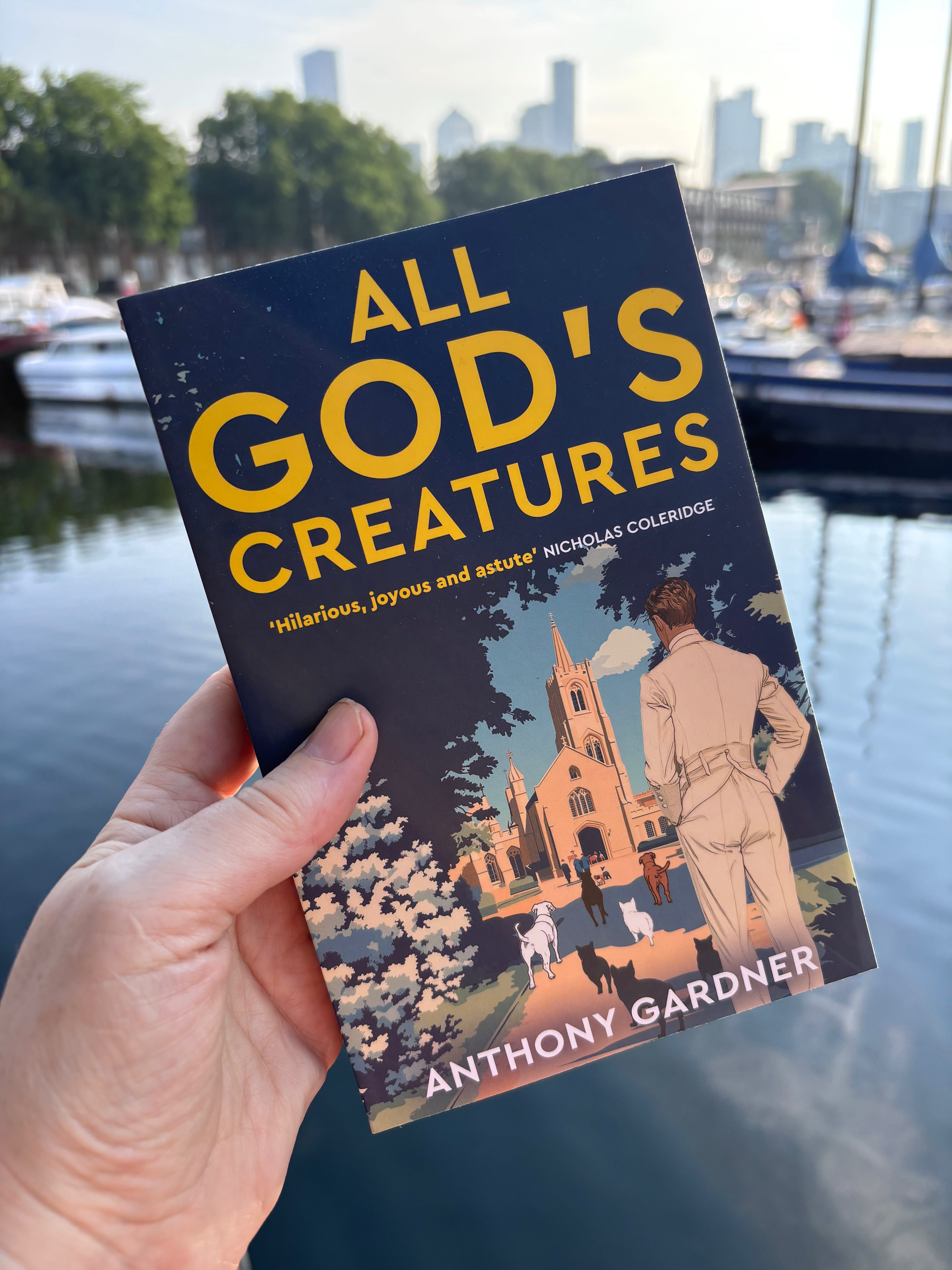
On Thursday 6 August, I’ll be at Waterstones Putney, chairing an evening with Anthony Gardner to celebrate his new novel, All God’s Creatures.
It is a darkly funny satire about fanaticism, greed, groupthink and the alarming ease with which a fringe opinion can move into the mainstream. Anthony and I will be discussing this excellent novel from 7–8.30pm.
I would love to see you there.
An Evening with Anthony Gardner
Thursday 6 August, 7–8.30pm
Waterstones Putney
Book your ticket here
Thank you for reading. Until next time,
Polly x